Nullam dignissim, ante scelerisque the is euismod fermentum odio sem semper the is erat, a feugiat leo urna eget eros. Duis Aenean a imperdiet risus.
Nullam dignissim, ante scelerisque the is euismod fermentum odio sem semper the is erat, a feugiat leo urna eget eros. Duis Aenean a imperdiet risus.
 author
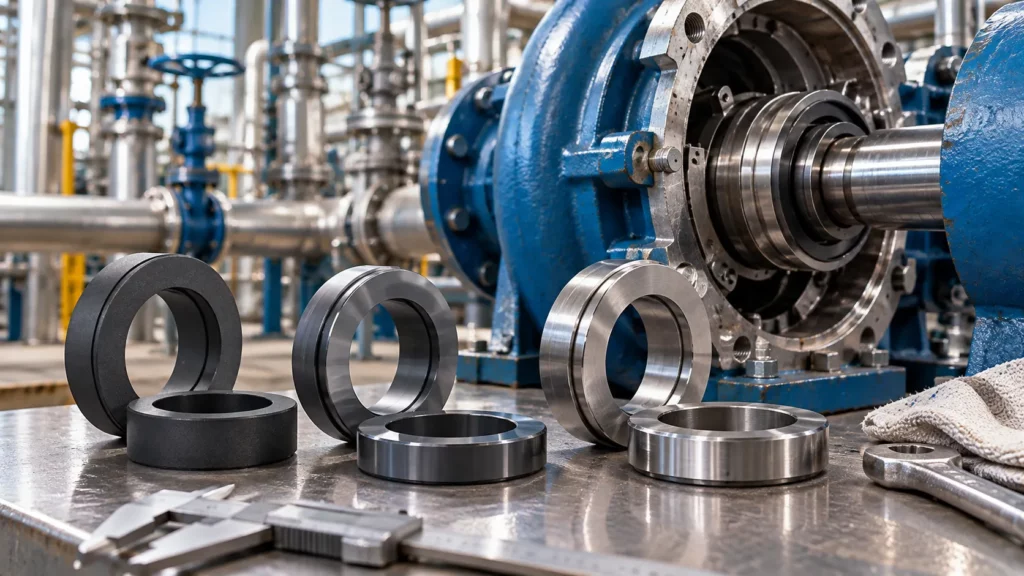
For most industrial mechanical seals, the practical choice is not simply silicon carbide (SiC), tungsten carbide (TC), or carbon. It is a face-pair decision. Carbon usually provides the more forgiving, lower-friction member of a pair; SiC is commonly evaluated when corrosion, abrasion, and heat transfer are major concerns; and TC is often considered when toughness, mechanical loading, and wear resistance matter. The correct answer depends on the actual fluid, solids, lubrication, pressure, speed, equipment condition, and the exact grade or binder. A material name alone is not a complete specification.
A useful selection process therefore starts with service conditions, compares the behavior of the complete face pair, and then checks whether the secondary seals and metal parts are compatible with the same duty. This guide focuses on the face decision so engineers and buyers can compare SiC, TC, and carbon without treating hardness as the only criterion.
Carbon, SiC, and TC are commonly used as rotating or stationary face materials. PTFE, FKM, and FFKM usually serve different functions, such as O-rings, gaskets, bellows, wedges, or other secondary sealing elements. They should not be placed in one simple ranking. The face pair controls the sliding interface, while the secondary seal must retain sealing force and movement without swelling, hardening, cracking, or losing chemical compatibility. For the broader system-level decision, use the mechanical seal material selection guide.
This distinction matters in failure analysis. A carbon face can look acceptable while an incompatible FKM O-ring swells and restricts movement. Conversely, an FFKM or PTFE secondary seal does not protect a poorly lubricated face pair from thermal damage. Each material group must be selected for its own job and then verified as part of one seal assembly.
Carbon graphite is frequently paired with a harder counterface. Its useful low-friction and self-lubricating behavior can provide a margin when the fluid film is thin or operating conditions vary. Carbon also tends to act as the sacrificial member of the pair, which can make wear easier to manage than damage to two hard faces.
However, carbon is not one uniform material. Base formulation, density, resin or metal impregnation, and manufacturing quality affect chemical compatibility and temperature behavior. Abrasive particles can cut the face, and brittle grades can chip during handling. Specify the carbon grade and impregnant rather than writing only ‘carbon’ on a purchase order.
Silicon carbide is a hard face material commonly evaluated for corrosive chemicals, abrasive media, and duties that benefit from strong heat transfer. It can be used against carbon or as a SiC/SiC pair. Its chemical behavior is often attractive, but bonded and sintered grades may not behave identically, and the finished face still depends on flatness, surface condition, and installation quality.
SiC is also relatively brittle. Impact during installation, vibration, shaft movement, or uneven loading can chip a face even when its wear resistance is suitable. Two hard SiC faces may also generate damaging heat when lubrication is poor. Dry contact, flashing, startup conditions, and flush reliability must be reviewed before selecting the pair.
Tungsten carbide is often chosen where toughness, high mechanical loading, and resistance to wear are priorities. Its density and impact tolerance can make it useful in demanding rotating equipment, especially when the equipment condition or service creates mechanical stress that would concern the designer using a more brittle face.
The binder is part of the material specification, not a minor detail. Different binders can change corrosion behavior, so a TC grade that performs well in one liquid may be unsuitable in another. Buyers should confirm both the carbide and binder system, then check whether the anticipated chemistry, temperature, and solids exposure are within the supplier’s verified limits.
The table below is a screening tool. It identifies the questions that normally distinguish the pairings; it does not replace a chemical compatibility review or the seal manufacturer’s application limits.
| Face pairing | Why it may be considered | What must be checked |
| Carbon / SiC | Balanced option for many clean chemical and industrial services; carbon provides the more forgiving face. | Carbon grade, fluid lubricity, corrosion, solids, and startup conditions. |
| Carbon / TC | Useful where a forgiving carbon face is paired with a tough hard face. | TC binder chemistry, carbon impregnant, mechanical load, and abrasive content. |
| SiC / SiC | Often evaluated for corrosive or abrasive media where hard faces are needed. | Lubrication, dry-contact risk, heat generation, vibration, and exact SiC grades. |
| TC / SiC | May combine TC toughness with SiC corrosion and wear behavior in demanding service. | Which face rotates, binder compatibility, impact risk, lubrication, and equipment condition. |
Before approving a face pair, document the complete operating envelope rather than one normal-duty value:

For clean, lubricating liquids, a carbon/hard-face pair may provide a practical balance of friction behavior and serviceability. For abrasive or corrosive media, SiC/SiC or another hard-face combination may be evaluated, but only with adequate lubrication and a controlled seal environment. Where shock, pressure, or equipment movement is a concern, TC may deserve closer review. These are selection directions, not universal rules; the final choice depends on the seal design and the material grades available.
Failed parts can provide useful evidence. Polished grooves and scoring may point to particles or deposits; chipping may suggest impact, handling damage, or vibration; discoloration or thermal cracks may indicate poor lubrication, flashing, or dry contact. An engineer should compare the damage pattern with operating history before changing materials. Otherwise, a more expensive face pair can fail for the same mechanical reason.
A useful RFQ identifies the equipment and service before requesting a material recommendation. Include the pump, reactor, mixer, or agitator model; shaft and chamber dimensions; existing seal drawing or sample; fluid and concentration; temperature; pressure or vacuum; speed; solids; cleaning conditions; observed damage; and required quantity. Buyers can review Xinyoumi’s pump mechanical seals and broader industrial mechanical seal products before submitting the application data.
Xinyoumi product documentation includes selected configurations using graphite/SiC, graphite/WC, SiC/SiC, and WC/SiC face combinations. Availability and suitability vary by product, size, and duty, so the quotation should identify the proposed rotating face, stationary face, exact grades, secondary-seal material, metal parts, and any required flush, cooling, quench, buffer, or barrier arrangement.
Carbon, silicon carbide, and tungsten carbide solve different parts of the mechanical seal face problem. Carbon can provide forgiving friction behavior; SiC is commonly evaluated for corrosion, abrasion, and heat transfer; and TC can add toughness and mechanical strength. The correct selection is the compatible pair that can maintain a lubricated, stable interface in the real equipment. Before ordering, verify the exact grades, binder or impregnant, secondary seals, metal components, and auxiliary conditions. To review a duty, request a material fit-check with the operating data, dimensions, drawing, and failure photographs.
No. SiC may be attractive for corrosion, abrasion, and heat transfer, while TC may be preferred when toughness and mechanical loading are more important. Grade, binder, fluid, lubrication, and equipment condition determine the result.
Carbon can provide low-friction, self-lubricating behavior and act as the more sacrificial member of the pair. Its grade and impregnant must still match the process fluid and temperature.
They may be evaluated for abrasive or corrosive service where two hard faces are useful. Lubrication, heat generation, dry-contact risk, vibration, and the exact SiC grades must be checked.
No. They are generally used for secondary sealing functions rather than the sliding face pair. Their chemical, temperature, pressure, movement, and installation requirements must be reviewed separately.