Nullam dignissim, ante scelerisque the is euismod fermentum odio sem semper the is erat, a feugiat leo urna eget eros. Duis Aenean a imperdiet risus.
Nullam dignissim, ante scelerisque the is euismod fermentum odio sem semper the is erat, a feugiat leo urna eget eros. Duis Aenean a imperdiet risus.
 author
A hot oil pump mechanical seal cannot be selected from process temperature alone. Thermal oil may operate reliably in the pump while the seal faces experience a different local combination of temperature, pressure, lubrication, friction, and vaporization risk. The correct seal also depends on face materials, secondary-seal architecture, cooling method, piping plan, and the consequences of leakage. For engineers replacing a leaking thermal oil seal, the key question is therefore not simply, “What seal can handle this temperature?” It is, “What sealing system can maintain a stable lubricating film under the actual operating conditions?”
Hot oil and heat-transfer-fluid pumps combine high process temperature with conditions that can be difficult for a conventional pump seal. The fluid may lose lubricity at the seal interface, local temperature may approach a vaporization condition, deposits may form around the faces, and secondary sealing elements may be exposed to temperatures different from the bulk oil temperature.
Before selecting a thermal oil pump mechanical seal, the application should define:
Xinyoumi provides industrial pump mechanical seals for different pump applications, but hot-oil selection should still be based on the complete duty rather than shaft size or a catalog temperature rating alone.
Bulk oil temperature is necessary for selection, but it is not necessarily the temperature experienced by every sealing component.
Heat reaches the seal through the process fluid, pump casing, shaft, and surrounding hardware. At the same time, face friction creates additional local heat. Pump geometry, seal position, chamber circulation, cooling jackets, and the piping plan can either remove that heat or allow it to accumulate.
This is why a pump carrying 250°C thermal oil should not automatically be treated as though every secondary seal and face component operates continuously at exactly 250°C. The actual condition around the mechanical seal may be lower or, at the face interface, locally more severe.
When possible, buyers should provide measured seal-area temperature together with bulk-fluid temperature. If that measurement is unavailable, provide the pump drawing, seal-chamber arrangement, operating speed, and current cooling or circulation system so the supplier can evaluate the thermal path.
Mechanical seal faces rely on a controlled fluid film. If local pressure and temperature conditions allow part of the fluid to vaporize at the interface, lubrication can deteriorate. Friction then increases, producing more heat and potentially accelerating face wear, thermal distortion, or leakage.
Repeated overheating should therefore trigger more than a search for a “higher-temperature seal.” Maintenance teams should inspect for face discoloration, heat checking, unusual polished areas, deposits, and evidence of inadequate circulation.
The next questions are practical: Is sufficient liquid reaching the faces? Is the seal chamber vented correctly? Is the cooling or recirculation path working? Has operating temperature increased since the original seal was specified?
Hot-oil seal face selection should not be reduced to “carbon versus silicon carbide” or “harder is better.” The correct pairing depends on lubrication, thermal behavior, startup conditions, surface speed, deposits, and chemical compatibility.
| Hot-Oil Condition | Face-Material Property to Prioritize |
|---|---|
| Stable, clean oil with good lubricity | Low friction and stable running behavior |
| Poor lubricity | Film performance and friction control |
| High local seal temperature | Thermal conductivity and distortion resistance |
| Coking or deposit tendency | Stable face condition and resistance to deposit-related damage |
| Startup or intermittent dry-contact risk | Short-duration dry-running tolerance |
| Contaminated or degraded oil | Wear resistance |
| Frequent thermal cycling | Thermal-shock resistance |
| Aggressive additives or degradation products | Chemical compatibility |
Proper mechanical seal face material selection should therefore use the actual hot-oil duty as the design basis. A face material that performs well in one heat-transfer fluid may not be the preferred choice where lubricity, contamination, thermal cycling, or dry-contact risk differs.
Materials matter, but they are only one part of the system. A premium face pairing cannot compensate indefinitely for poor cooling, vaporization, blocked circulation, or an unsuitable piping plan.
High-temperature service can make secondary-seal architecture an important selection variable.
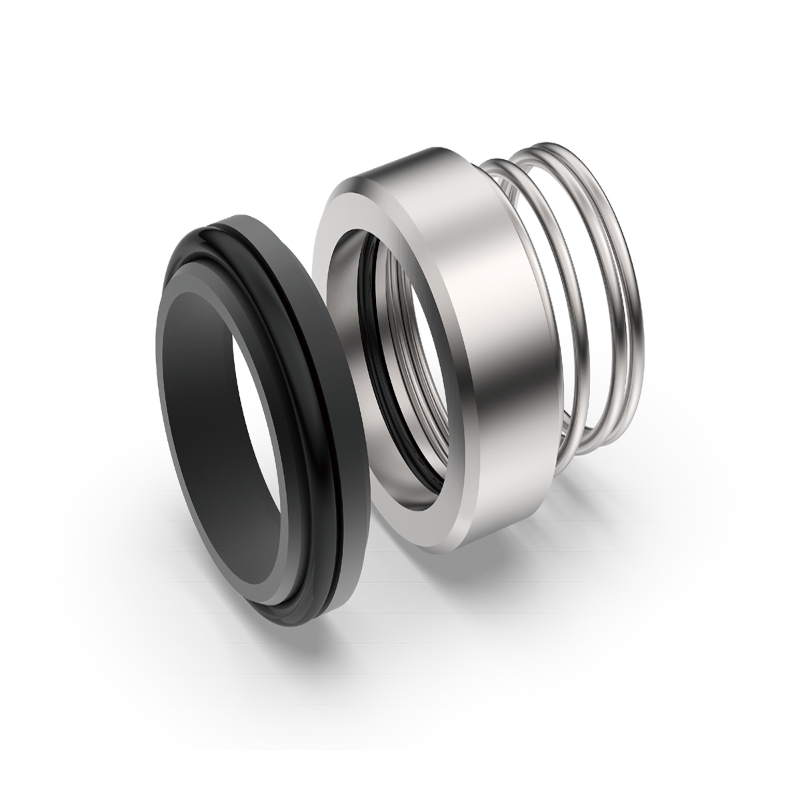
Conventional pusher seals rely on dynamic secondary sealing elements that must move as the seal compensates for wear and operating movement. Elevated temperature can affect elastomer properties and may make this dynamic component one of the limiting factors in severe hot-oil duty.
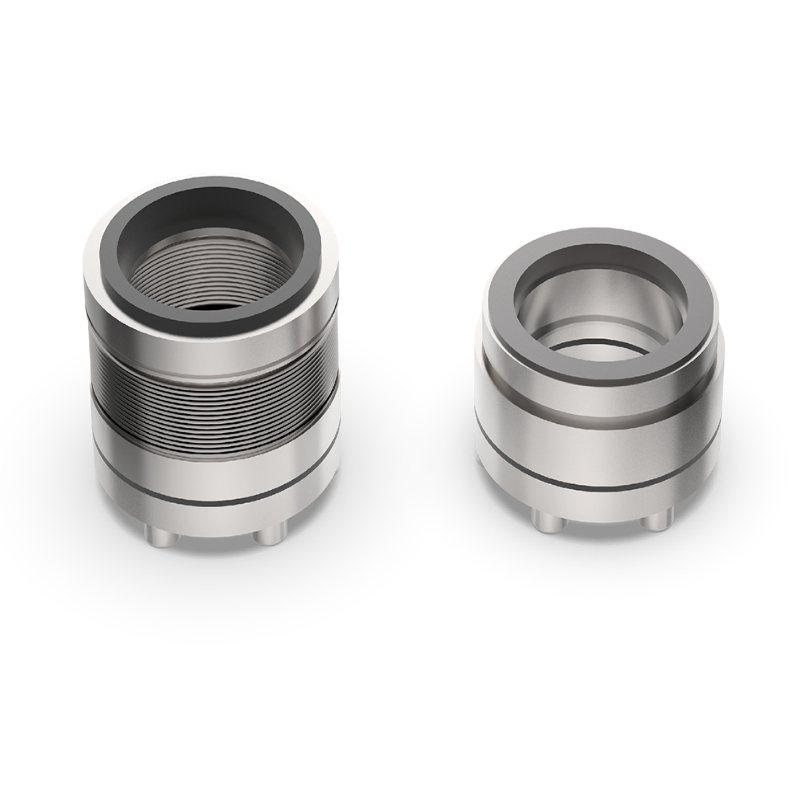
For this reason, metal bellows mechanical seals are often evaluated for high-temperature industrial applications. A bellows design can change how axial movement is accommodated and can reduce reliance on a dynamic elastomer in the same location.
That does not mean every thermal oil pump should use a metal bellows seal. Pressure, speed, fluid properties, shaft movement, available installation space, face pairing, and actual component temperature still matter. A bellows seal also needs an appropriate thermal-control strategy; changing the seal architecture does not remove heat from the chamber by itself.
Not necessarily.
The purpose of cooling is to keep the mechanical seal in an acceptable thermal and lubrication condition—not to cool the entire thermal-oil process. Some applications rely on a cooled seal chamber, some use cooled recirculation, and some pump designs reduce heat transfer to the seal through equipment geometry and natural or air-assisted heat dissipation.
The correct cooling decision should consider actual seal temperature, available vapor margin, face friction, oil properties, pump construction, and utility reliability.
A cooling-water system that frequently scales or plugs may create another failure mechanism. Likewise, applying aggressive cooling without considering fluid behavior can create undesirable viscosity or deposit conditions in some services. The thermal strategy should therefore be designed around the actual heat-transfer fluid and seal environment.
There is no single seal plan for every hot-oil pump. Plan selection should answer a specific question: Where does the heat need to be removed, and what fluid should be present around the seal faces?
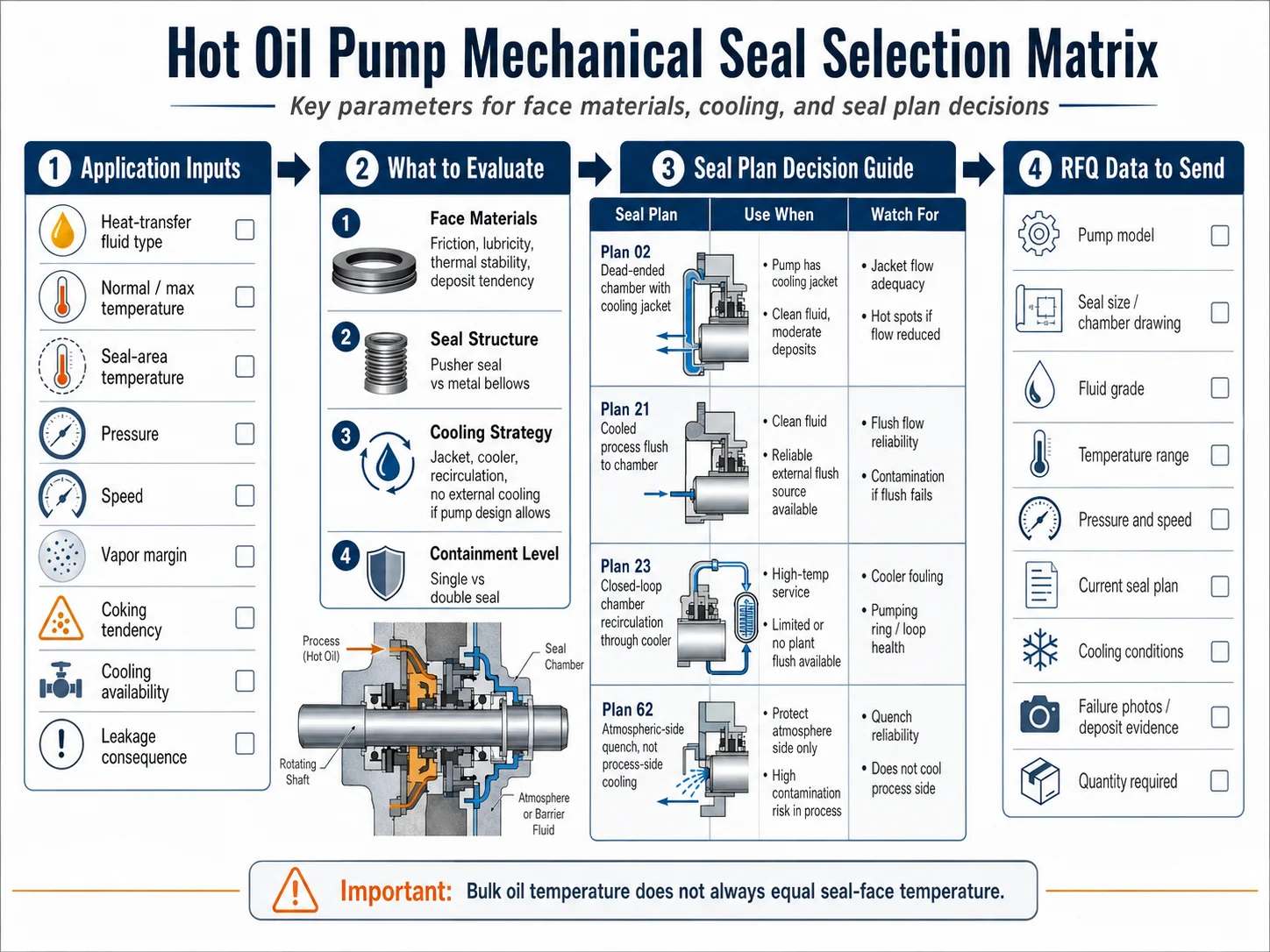
Plan 02 uses a dead-ended seal chamber without continuous process circulation through an external loop. In high-temperature applications, the seal chamber may be combined with cooling provisions.
This arrangement may be considered when the process fluid is sufficiently clean and the thermal condition can be controlled without continuous recirculation. However, the application needs adequate margin against vaporization at the seal faces.
Cooling-jacket condition also matters. Fouling, low utility flow, or an incorrectly operated jacket can raise seal temperature even though the seal itself has not changed.
Both Plan 21 and Plan 23 can introduce cooling, but they manage heat differently.
Plan 21 takes process fluid from the pump discharge, passes it through a cooler, and directs it to the seal chamber. It cools a stream originating from pump discharge conditions.
Plan 23 instead circulates fluid from the seal chamber through a cooler and back to the chamber. This concentrates the cooling duty around the seal environment rather than continuously cooling a larger flow taken from pump discharge.
For hot service, Plan 23 may be attractive when the pump and seal configuration support a controlled closed-loop seal-chamber circuit. The choice still depends on circulation capability, chamber design, pressure conditions, cooler performance, and the specific fluid.
The procurement question should therefore be: Which plan maintains the required seal temperature and lubrication with the least unnecessary thermal disturbance to the process?
Plan 62 is frequently misunderstood in high-temperature service. It provides a quench on the atmospheric side of a single mechanical seal. Depending on the application, the quench medium may help manage deposits, coking, leakage residue, or atmospheric-side temperature conditions.
It is not the same as cooling the process-side seal chamber.
If faces are overheating because the process-side fluid film is unstable, adding an atmospheric-side quench does not automatically correct the cause. Buyers should therefore distinguish clearly between a quench, a process-side flush, and a cooled seal-chamber circulation loop when reviewing quotations.
A hot oil pump can operate with either single or double sealing arrangements depending on the application.
A double seal deserves evaluation when the heat-transfer fluid has significant leakage consequences, when vapor behavior makes atmospheric leakage undesirable, or when the process requires a more controlled environment around the inboard seal. Synthetic and mineral heat-transfer fluids can also differ in physical properties, so the medium itself matters.
A double seal introduces additional decisions involving buffer or barrier fluid compatibility, pressure control, heat removal, monitoring, and support equipment. It should therefore be selected because the containment requirement justifies it—not simply because the process temperature is high.
Catalog temperature capability does not prove that the complete installation is operating within a safe thermal condition.
A correctly rated seal can still fail because of:
Repeated seal failure is therefore a system-level diagnostic problem. Increasing the nominal temperature rating without investigating these factors may simply postpone another leak.
Before ordering an identical replacement, inspect the failed seal and surrounding system.
Check whether the faces are polished normally or show heat discoloration, cracking, scoring, or deposits. Inspect elastomers, bellows, springs, chamber surfaces, cooling lines, and piping-plan connections. Verify that the cooler or jacket is actually passing the required utility flow.
Also compare present operating conditions with the original specification. Has the thermal oil grade changed? Has maximum temperature increased? Is the pump now operating continuously instead of intermittently? Has the system pressure or speed changed?
A like-for-like replacement is reasonable only when the original thermal design basis remains valid.
A technically useful RFQ should include:
This information helps separate a straightforward dimensional replacement from an application that needs revised faces, seal architecture, cooling, or piping.
A high-temperature seal supplier should be able to explain the thermal basis behind the proposed configuration rather than quoting a maximum temperature alone.
A useful technical review should ask about the heat-transfer-fluid grade, process temperature, pressure, speed, seal-chamber design, current seal plan, cooling availability, failure evidence, and operating cycle.
Xinyoumi’s pump-seal and industrial sealing portfolio provides a basis for evaluating these application variables, but the suitable configuration should still be confirmed against the actual pump and operating conditions.
A quotation should identify the proposed face-material direction, secondary-seal or bellows architecture, cooling requirement, piping plan, and single or double arrangement where applicable.
It should also distinguish confirmed information from assumptions still requiring customer verification. This is particularly important in hot-oil service because a seal that fits mechanically can still be unsuitable thermally.
Hot oil pump mechanical seal selection should treat the seal as part of a thermal and hydraulic system. Bulk oil temperature matters, but so do local face temperature, vaporization margin, lubrication, face materials, secondary-seal architecture, cooling, and the piping plan.
Before replacing or specifying a thermal oil seal, collect the pump and chamber drawings, oil grade, temperature and pressure range, speed, existing seal plan, cooling conditions, failed-seal photographs, deposit evidence, and required quantity. Buyers can contact Xinyoumi with these details for application review and quotation.
The appropriate design depends on actual seal temperature, pressure, speed, fluid properties, lubrication, leakage requirements, and cooling strategy. Metal bellows seals may be evaluated for high-temperature service, but they are not required for every application.
Face selection depends on lubricity, local seal temperature, coking tendency, thermal cycling, wear, chemistry, and dry-contact risk. There is no single face pair that is appropriate for every thermal-oil application.
Not necessarily. Some systems use water-cooled jackets or heat exchangers, while other pump and seal arrangements manage temperature differently. The correct approach depends on actual seal temperature and the pump’s thermal design.
Plan 23 may be suitable when a cooled closed-loop seal-chamber circuit can maintain the required face environment efficiently. Pump geometry, circulation capability, fluid behavior, pressure, and cooler performance must still be checked.
Provide the pump and existing seal details, heat-transfer-fluid grade, temperature, pressure, speed, viscosity, chamber drawing, current piping plan, cooling conditions, leakage requirements, operating cycle, and evidence from any previous seal failure.